
Dilmun: The Ancient World's Trading Hub
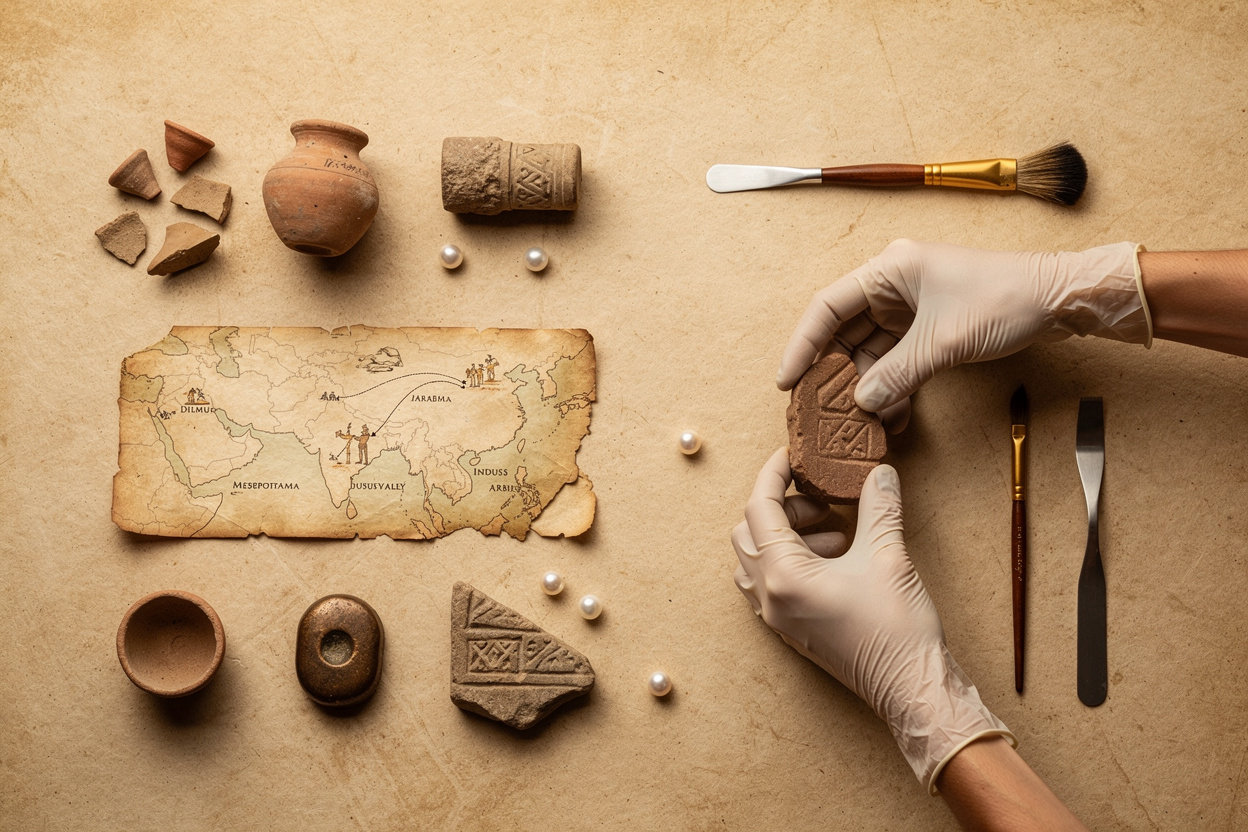
Between 2300 and 1800 BCE, Dilmun flourished as one of the ancient world's most crucial maritime civilizations. Positioned at the crossroads of Mesopotamia, the Indus Valley, and Arabia, this island kingdom controlled trade routes that connected three continents and shaped the economic and cultural fabric of the Bronze Age.
Qal'at al-Bahrain served as Dilmun's capital—a fortified harbor city where merchants, artisans, and administrators built a civilization that lasted over 4,000 years. The tell mound beneath your feet contains the layered remains of this remarkable history: seals bearing Sumerian inscriptions, pottery from the Indus Valley, and evidence of governance systems that influenced empires.
4,000 Years of Continuous Settlement
Qal'at al-Bahrain's tell mound preserves distinct layers of human habitation spanning four millennia. Each stratum reveals how successive civilizations adapted to the landscape, shaped governance, pursued trade, and left behind the artifacts that now populate our museum's five exhibition halls.
Early Settlement Period
Bronze Age Origins
The earliest occupation layers at Qal'at al-Bahrain date to the Bronze Age, when maritime communities first established permanent settlements on the island. Archaeological evidence reveals simple dwellings, fishing tools, and early pottery—markers of a people adapting to coastal life and beginning to exploit Bahrain's strategic position in the Gulf.
What artifacts reveal: Fishing hooks, simple hand-thrown pottery, bone tools, and evidence of seasonal occupation patterns that would evolve into permanent settlement.
Dilmun Capital Period
Peak Civilization & Trade Hub
This was Qal'at al-Bahrain's golden age. As the capital of Dilmun, the site flourished as a major trading hub connecting Mesopotamia, the Indus Valley, and Arabia. The tell grew substantially with the construction of monumental buildings, administrative centers, and residential quarters. Archaeological layers reveal a sophisticated urban society with organized governance, diverse craftsmanship, and extensive international commerce.
What artifacts reveal: Standardized seals bearing Dilmun inscriptions, imported lapis lazuli and carnelian from the Indus, Mesopotamian cylinder seals, weights and measures for trade, elaborate pottery, and architectural remains of civic and residential structures housing a cosmopolitan population.
Later Settlement Periods & Transitions
Continuity Through Change
After Dilmun's decline, Qal'at al-Bahrain remained inhabited—a testament to the site's enduring appeal and strategic value. Subsequent periods saw shifts in architecture, trade patterns, and cultural practices, yet settlement persisted. The tell continued to grow as new communities built atop the remains of their predecessors, creating the complex stratigraphy archaeologists uncover today.
What artifacts reveal: Changes in pottery styles and manufacturing techniques, evidence of modified trade networks, religious objects reflecting new spiritual practices, and architectural adaptations showing how inhabitants adjusted to evolving economic and social conditions.
Reading the Tell Mound
Archaeology's Layered Archive
The 17.5-hectare artificial tell is essentially a time capsule. Each layer—separated by ash, sand, or soil—marks a distinct period of occupation. By excavating these strata carefully, archaeologists piece together a chronological narrative of settlement, abandonment, rebuilding, and cultural change. The preservation of settlement layers in the tell mound is exceptional, offering an unparalleled record of continuous human habitation in the Arabian Gulf.
Why it matters: The tell's stratigraphic integrity allows us to understand not just individual artifacts, but entire systems of daily life, trade, governance, and social organization across millennia—making Qal'at al-Bahrain one of the world's most significant archaeological sites for understanding ancient Gulf civilization.
The Museum Experience
Our five exhibition halls showcase more than 500 artifacts drawn from these settlement layers. Walking through the museum, you'll encounter pottery vessels used in daily cooking, seals that authenticated trade goods, tools that reveal craftsmanship, religious objects that speak to spiritual life, and architectural fragments that hint at the grandeur of civic structures. Each artifact is a window into the lives of the people who lived here—their ambitions, their trade networks, their beliefs, and their adaptability across four millennia of change.
When you visit Qal'at al-Bahrain, you're not just seeing a collection of objects. You're reading a continuous story written in stone, pottery, and metal—a story of human resilience, cultural exchange, and the enduring appeal of a place where land, sea, and commerce converge.
Ready to explore these layers in person?
Trade, Culture & Daily Life in Ancient Dilmun
The artifacts uncovered at Qal'at al-Bahrain tell vivid stories of how people lived, worked, and connected across the ancient world. From the seals of merchants to the pottery of everyday homes, each object reveals the sophistication and cosmopolitan nature of Dilmun's society.
Trade Goods & Long-Distance Connections
Dilmun's wealth came from its position as a crossroads between Mesopotamia, the Indus Valley, and Arabia. Excavations at Qal'at al-Bahrain have uncovered:
- • Imported ceramics and stone vessels from Mesopotamia and the Persian Gulf region, revealing established trade routes
- • Weights and measures standardized for commercial exchange, proving sophisticated accounting practices
- • Seals and stamp impressions used to authenticate goods and mark ownership—some bearing Mesopotamian and Indus Valley scripts
- • Lapis lazuli, carnelian, and other semi-precious stones sourced from Afghanistan and the Arabian Peninsula
Administrative Authority & Governance
The discovery of administrative seals and clay tablets demonstrates that Dilmun was not merely a trading post, but a seat of organized government. These artifacts show:
- • Official seals of rulers and administrators used to authorize documents and contracts
- • Written records in cuneiform script, indicating literacy and bureaucratic systems
- • Civic structures organized by function—residential quarters, administrative buildings, and storage facilities
Domestic Life & Household Crafts
The pottery, tools, and household items found in residential structures reveal the rhythms of daily life:
- • Ceramic vessels for cooking, storage, and serving—many bearing distinctive geometric and floral patterns
- • Copper and bronze tools including axes, chisels, and fishing implements showing specialized craftsmanship
- • Food remains and animal bones that reveal diet: fish, shellfish, domesticated animals, and grain
- • Jewelry and ornaments in shell, bone, and stone, indicating craftsmanship and personal adornment traditions
Religious Practices & Ritual Life
Religious structures and ritual objects found at the site illuminate spiritual beliefs:
- • Temple remains indicating organized religious institutions and worship spaces
- • Votive offerings and ritual vessels used in religious ceremonies and deity worship
- • Figurines and amulets for protection and spiritual practice
- • Burial practices reflecting beliefs about the afterlife and social hierarchy
Explore 500+ Artifacts in the Museum
The on-site museum at Qal'at al-Bahrain houses over 500 artifacts organized across five exhibition halls. Each piece is a window into ancient Dilmun's sophistication:
Pottery & Ceramics
Vessels revealing trade connections and domestic practices
Seals & Weights
Evidence of commerce, administration, and standardized exchange
Tools & Implements
Copper, bronze, and stone tools for daily work and craftsmanship
Jewelry & Ornaments
Shell, bone, and stone pieces showing artistry and personal expression
Religious Objects
Figurines, votive offerings, and ritual vessels for spiritual practice
Architectural Elements
Remains of buildings revealing urban planning and construction methods
Audio guides are available to enhance your museum experience, offering expert commentary on key artifacts and their historical context.
A Cosmopolitan Society
What emerges from the archaeological record at Qal'at al-Bahrain is a picture of a sophisticated, interconnected society. Dilmun was not isolated—it was a hub where merchants, craftspeople, administrators, and families from across the ancient world converged. The artifacts speak to shared values, practical innovations, and cultural exchange that shaped the Bronze Age Mediterranean and beyond.
When you walk through the museum's exhibition halls and explore the 17.5-hectare mound, you're literally walking through layers of this history. Each artifact, each architectural foundation, each potsherd tells a human story—of trade negotiations, family meals, religious ceremonies, and the daily work of building and maintaining a thriving civilization.
Experience Ancient Dilmun in Person
The artifacts and structures at Qal'at al-Bahrain come alive when you visit. Spend 2–3 hours exploring the museum's five exhibition halls, walking the ancient mound, and discovering the evidence of 4,000 years of continuous human settlement.
Step Into 4,000 Years of History
Reading about Dilmun is one thing. Standing on the ancient mound, walking through the museum's five exhibition halls, and holding centuries of history in your hands—that's something else entirely.
500+ Artifacts Across Five Exhibition Halls
Pottery, seals, tools, and trade goods spanning 4,000 years of continuous settlement. Every artifact tells a story of daily life, commerce, and culture in the ancient capital of Dilmun.
The 17.5-Hectare Mound
Explore the artificial tell—one of the world's largest—where centuries of settlement are layered beneath your feet. Walk the paths where merchants, rulers, and families once lived.
Coastal Setting & Seaside Café
Relax at the site's café with views of the sea and palm groves. The same waters that brought ancient traders to Dilmun's harbor stretch out before you.
Ready to experience Qal'at al-Bahrain in person?
Plan Your VisitUNESCO World Heritage
Recognized globally for archaeological significance
Open Daily
8:00am – 8:00pm
Museum closed Mondays
UNESCO World Heritage
Recognized globally for archaeological significance
Open Daily
8:00am – 8:00pm
Museum closed Mondays